
 English
 Deutsch


Paris has stopped looking like the weakest part of France’s housing market, but at almost EUR 9,600 per square metre it still gives investors very little room for error.
Research date: 13 November 2026.
France’s housing market is sending two messages at once. National prices are falling again, sales have stopped recovering and government bond yields have climbed close to 5 percent. Yet Paris apartment prices are barely lower than a year ago.
This is not a simple buy-or-avoid signal. Paris is showing real resilience, but the financial conditions around it are becoming less forgiving. For investors, that makes 2026 a market for selection and negotiation, not a market for assuming that a famous postcode will do the work.
The recovery has stalled before prices recovered
French existing-home prices fell 1.0 percent in the second quarter of 2026 and were 0.8 percent lower than a year earlier, according to INSEE. Apartments were almost flat over the year, while house prices fell 1.3 percent.
The more revealing number is activity. France recorded an estimated 958,000 existing-home transactions in the 12 months to June. That was barely above 953,000 in March and 952,000 at the end of 2025. The rebound that began in late 2024 has flattened, and turnover remains far below the 1.248 million peak reached in 2021.
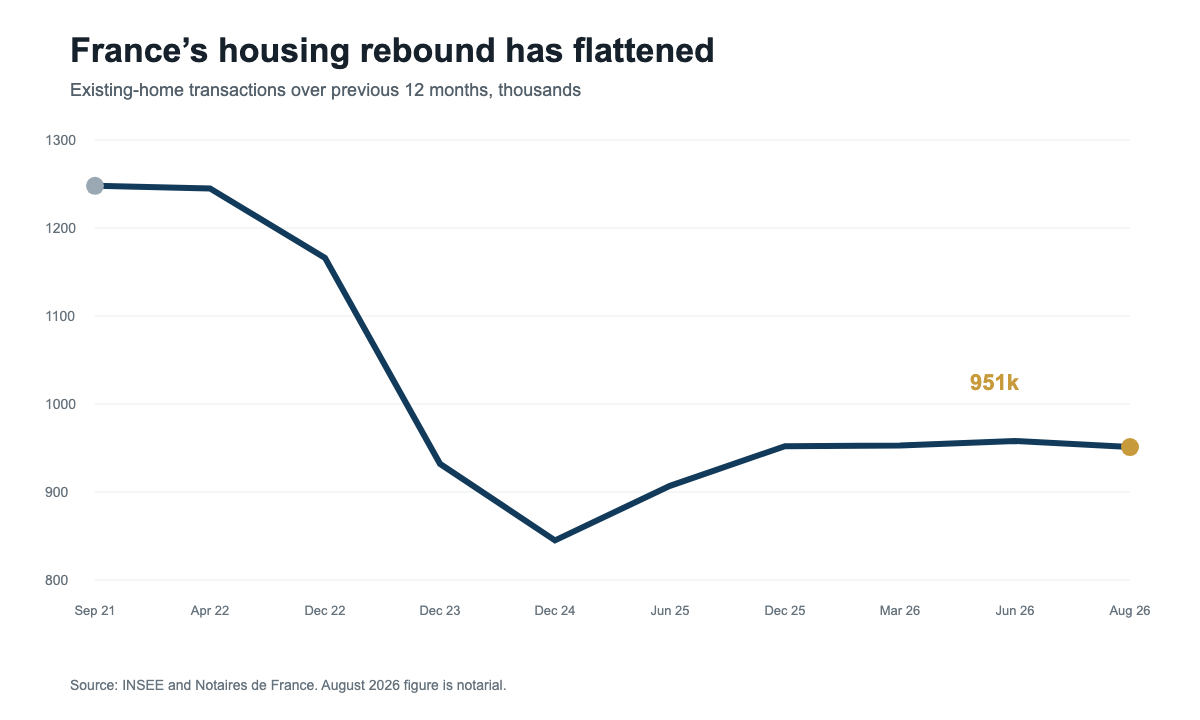
The latest notarial data point in the same direction. Sales over the 12 months to August reached 951,000. In Île-de-France, 33,660 existing homes changed hands from June to August, 2 percent fewer than in the same period of 2025. Paris sales were also down 2 percent.
This is how a market often weakens before the headline price looks dramatic. Buyers retreat first. Sellers take longer to accept the new financing reality. Transactions disappear in the gap.
Paris is resisting, not escaping
Paris apartments averaged EUR 9,590 per square metre at the end of August, only 0.5 percent below a year earlier, according to the Notaires du Grand Paris. Preliminary contracts pointed to roughly EUR 9,580 per square metre in November, a 0.4 percent annual fall.
That is stronger than the national picture. It is not evidence that Paris has decoupled from France. The capital has genuine advantages: constrained supply, international demand and prime neighbourhoods that rarely behave like an average French town. But resilience at EUR 9,580 per square metre is expensive resilience.
At that price, EUR 250,000 buys about 26 square metres before acquisition costs. Paris is not scored in the PFC Property Investor Index, but its common-budget benchmark provides a useful control: the same capital reaches about 38 square metres in Prague, 44 in Lisbon, 70 in Budapest, 78 in Sofia and 103 in Bucharest.
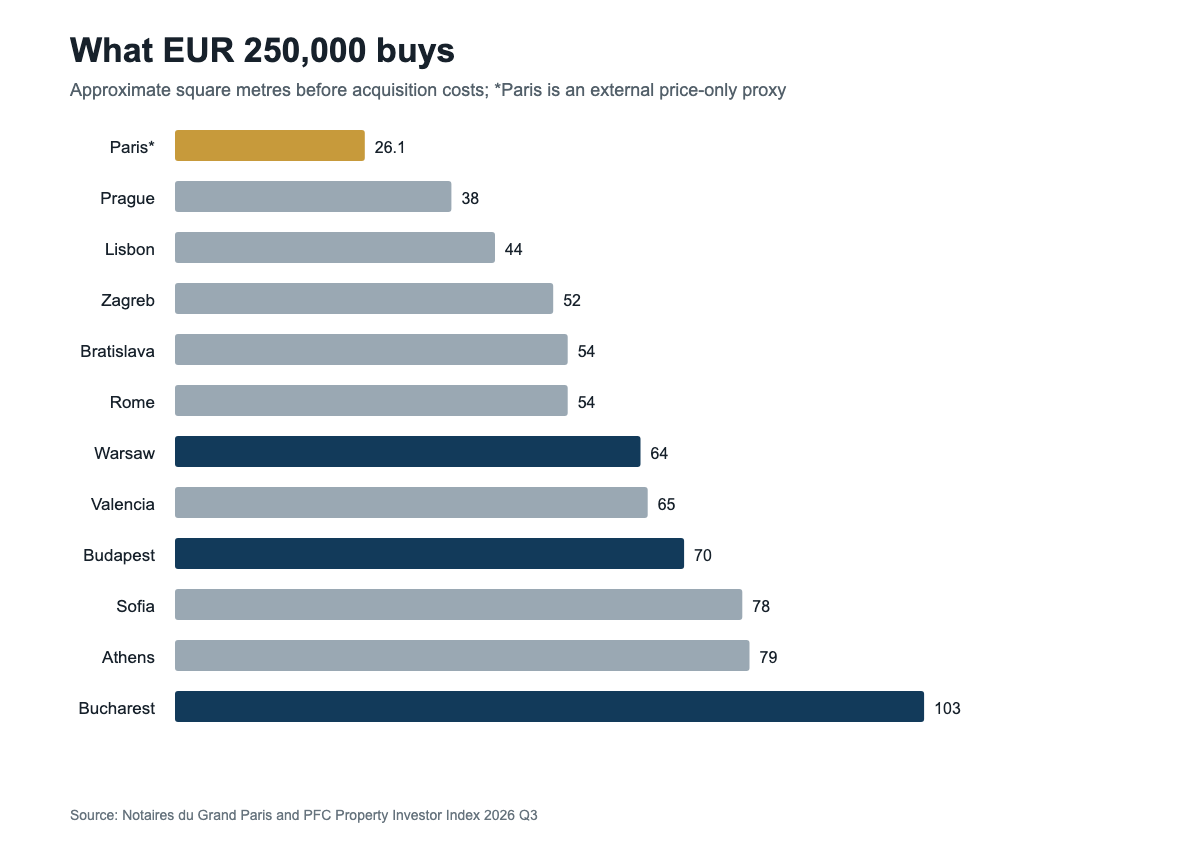
Paris may preserve capital better than weaker French markets, but the buyer starts with little space and little room for error.
The bond market has changed the calculation
On 13 November, France’s official ten-year reference yield, the TEC 10, stood at 4.89 percent, according to Agence France Trésor. At the government’s 5 November auction, a bond maturing in 2036 cleared at a weighted average yield of 4.74 percent.
That does not mean mortgage rates mechanically follow government yields. It does mean that the price of long-term money, and the return available from a liquid government security, has risen sharply. Property now has to clear a higher hurdle.
The average rate on new French housing loans excluding renegotiations was 3.32 percent in September, up from 3.09 percent a year earlier. New loan production slipped to EUR 11.8 billion from EUR 12.2 billion in August, while outstanding housing credit to individuals grew by just 0.2 percent year on year, according to the Banque de France. The same negotiating pattern appears in our analysis of weaker European mortgage demand: failed financing can improve a buyer’s position only when the problem belonged to the previous buyer, not to the property.
For a leveraged buyer, the squeeze is immediate: the asset remains costly, debt is no longer cheap and resale liquidity is lower. For a cash buyer, the opportunity cost has changed. A low-yielding apartment must justify its illiquidity, costs and maintenance against a bond yield close to 5 percent.
What investors give up at this entry price
A cross-city control cannot score Paris directly. It can still show what investors give up by concentrating on the French capital.
Warsaw combines a 5.59 percent gross yield benchmark with 64 square metres of purchasing power for EUR 250,000. Bucharest offers 103 square metres and a 4.60 percent yield. Sofia offers 78 square metres, roughly 4.0 percent gross yield and the strongest resilience score in the 11-city group. Budapest offers 70 square metres and ranks third for five-year potential. The Budapest investment case shows how a lower-cost capital can trade space and income against currency risk.
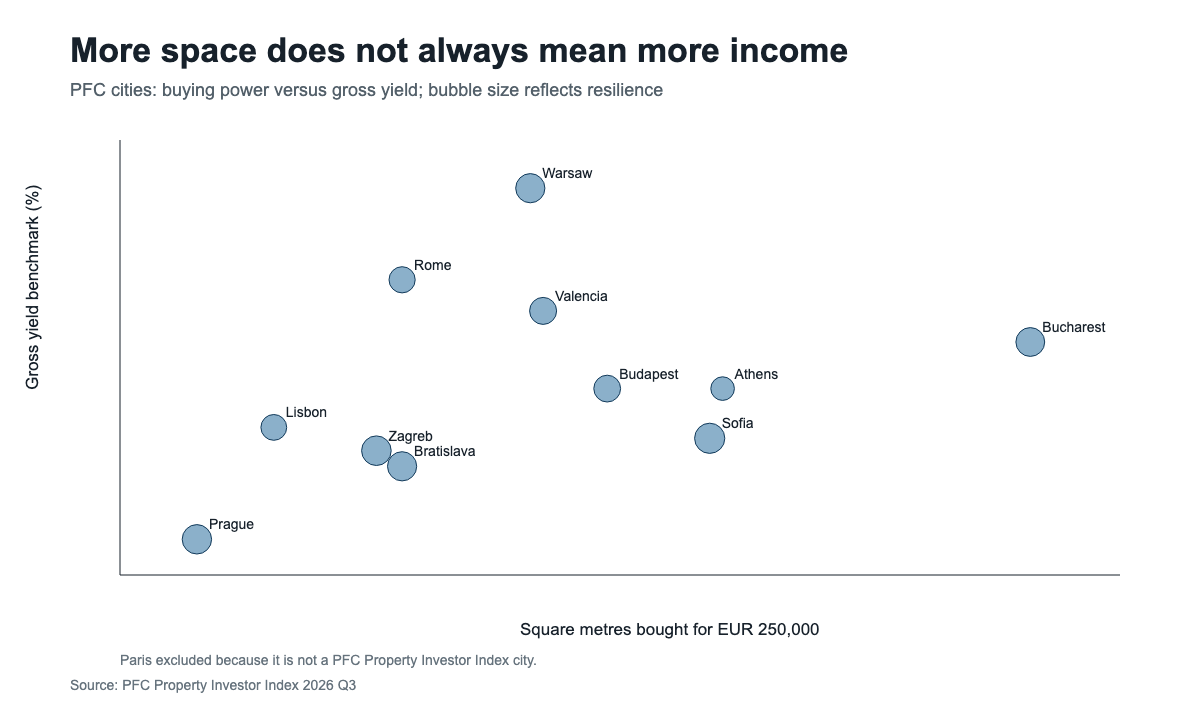
These cities carry their own currency, regulatory, development and political risks. Cheaper does not automatically mean safer. The point is that investors elsewhere begin with more income or more space, often both. Paris begins with scarcity and prestige. In a high-hurdle environment, that is not enough on its own.
Prague provides a useful warning. It has the second-smallest purchasing footprint in the Index and the lowest gross yield, while still showing high resilience. A city can be fundamentally strong and still offer a weak entry point. Paris may be an even more extreme version of that distinction.
A property-level opportunity, not a citywide call
Paris is not an obvious bargain, and France is not in a disorderly housing collapse. The useful conclusion sits between those claims.
The current market gives serious buyers something they lacked during the boom: time. Fewer transactions and more expensive credit can create negotiating power, especially for homes with poor energy performance, renovation needs, awkward layouts or sellers facing a deadline. But a discount becomes an opportunity only if it is larger than the building risk, improvement cost and income shortfall it is meant to compensate for.
Investors seeking a broad margin for error can still find more starting income and more physical asset in several PFC cities. Buyers who specifically want Paris now need a property-level thesis. The street, energy rating, building accounts, tenant rules and achievable rent matter more than the Paris name.
Paris prices are holding while the French market beneath them loses momentum. As our review of Europe’s property turn shows, the useful opportunities now sit at property level rather than in a broad market call. This is not a final warning to leave Paris. It is a warning to stop buying the postcode and start underwriting the apartment.