



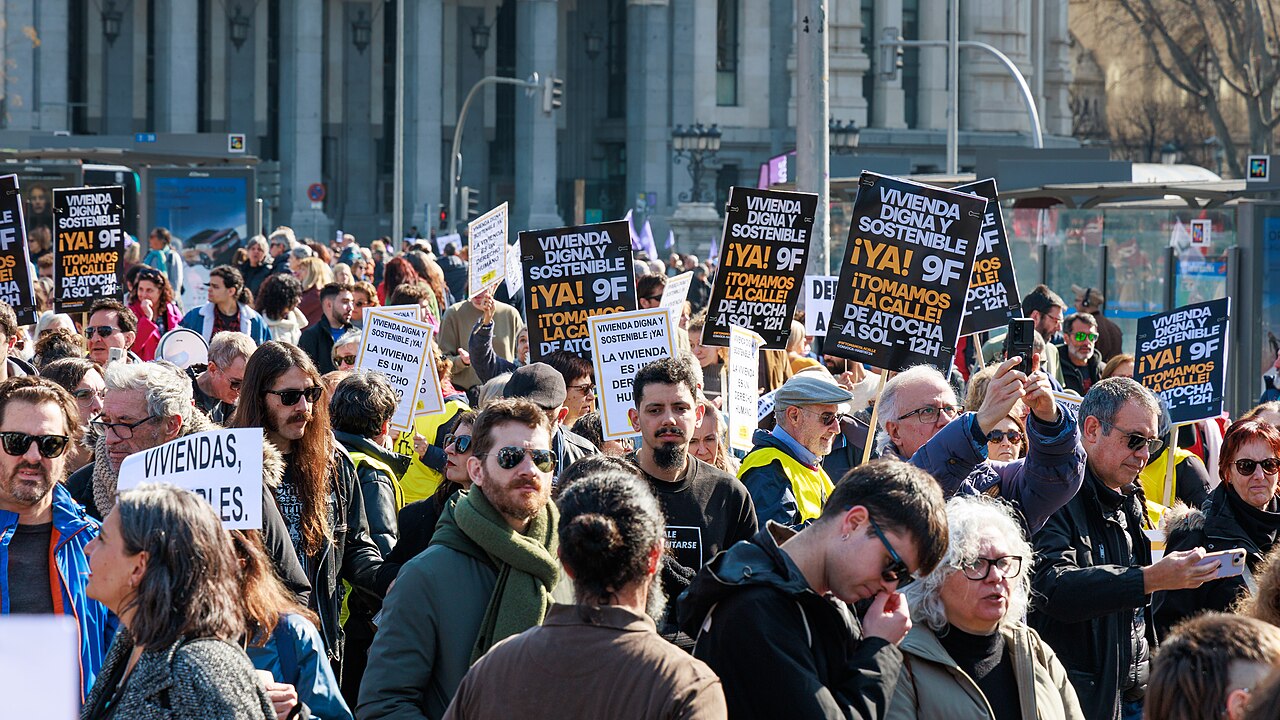
Europe needs more rental homes. Yet as housing anger reaches the streets, private investors are often the first target of higher taxes, tighter rules and political blame.
Renters need protection and cities need more affordable housing. But when policy only cuts the return from long-term renting, raises buying costs or pushes owners towards other uses, it can reduce the number of homes available to future tenants.
Private investment and affordable housing are not natural enemies. A market is usually calmer when vulnerable households have a real non-market option and private landlords can still earn a viable return from supplying and managing ordinary long-term homes.
The investor advantage is in reading this balance before the market fully prices it. A loud housing shortage is not automatically a buy signal. The better opportunity is a city where demand is structural, long-term renting remains legally and financially viable, and public housing absorbs part of the social pressure without replacing the private market.
The practical trick is to separate the property from its operating model. A good home can remain useful under several sets of rules. A deal that works only as an Airbnb, one tax break or an unaffordable rent is a regulatory bet disguised as property investment.
Milan shows how quickly this balance can fail. On 26 September 2026, about 1,500 people joined a march whose documented housing demands opposed high rents, evictions and forced removals. Three weeks later, tenant unions and neighbourhood groups held a focused Sfratti Zero action. They demanded an end to evictions without rehousing, the assignment of vacant public homes and more emergency accommodation.
On 20 October, 32 tenant families in Viale Molise said they feared losing their homes after their building was offered to a property fund. The sale became a test of whether investment capital would add stable housing or remove it.
Milan’s shortage is changing shape
Milan’s problem is not only that rent is high. Permanent rental supply is also losing ground. The 2026 report from Milan’s Affordable Housing Observatory found that the weighted average rent on newly registered contracts rose from €189 per square metre a year in 2023 to €201 in 2024, a 6.8% increase. The contract mix moved almost as sharply. Long-term agreements represented 66% of new rentals in 2020, but only 51% in 2024. Temporary, student and short-term contracts rose from 34% to 49%.
A city can add rental activity without adding stable homes. The OCA model also estimated that a worker on its average wage could afford only 25 square metres if housing costs were limited to 30% of net pay. An office employee could afford 34 square metres.
Scarcity still supports occupancy. But when local employees cannot secure an ordinary home, the debate changes. It stops being only about price and becomes a dispute over which uses of housing should receive political protection.
Why one eviction moved Madrid
Madrid shows what happens when a long-running shortage finds a human trigger.

The eviction of 87-year-old María del Carmen Abascal from the home where she had lived since 1955 sparked a wider mobilisation. Tenant organisations connected one case to a national argument over rent, evictions and housing as an investment asset.
On 3 October, more than 50 housing marches took place across Spain. The Government Delegation counted 70,000 people in Madrid. Organisers claimed 500,000. The range is too wide to collapse into one number, but even the official estimate was far larger than the recent actions in Milan or Budapest.
Madrid had an identifiable case, an established tenant union, clear demands and a live parliamentary fight. Spain’s Congress had rejected two housing decrees the day before the marches.
For investors, the lesson is that affordability data can remain abstract for years, then one visible eviction or sudden contract change can turn it into a mass issue.
When regulation protects one tenant but removes the next home
Tenant protection is not the problem. The risk appears when governments control the price or use of existing homes without creating enough additional supply.
Die IMF’s 2026 review of Spain summarised studies of Catalonia’s 2020 rent-control regime. They found moderate rent reductions of about 4% to 6% for affected homes, but also declines of roughly 15% to 30% in new rental listings. The exact size varies by study, yet the direction is a warning. A lower regulated rent helps the tenant who already has the home. A smaller rental stock makes the search harder for the next tenant.
Die OECD reaches a similar conclusion. Overly tight rent controls and landlord rules can lower expected returns, reduce residential investment and encourage owners to sell or move homes into other uses. This is not an argument for weak tenant rights. It is an argument for balanced rules and more homes.
Entry taxes can create the same problem more quietly. They may discourage short-term speculation, but they also raise the return that a long-term landlord needs before providing a home. If the city does not replace that lost capital with public, cooperative or institutional supply, the policy can leave fewer rental choices rather than more.
Budapest is quieter for structural reasons
Budapest also held a Housing March in October 2026, but one report described a crowd of only a few hundred. The smaller turnout does not mean that housing is affordable.
Tenure helps explain the difference. Eurostat reported that 91% of Hungary’s population lived in an owner-occupied home in 2023. Magyar Nemzeti Bank analysis of the 2022 census found that 16% of Budapest residents were renters. Family property, inheritance and subsidised ownership absorb part of the pressure that would otherwise appear directly in a large rental market.
Budapest therefore has a different risk. Its rental sector is smaller, but a well-managed long-term home can still meet real demand. The investment must work at a rent local tenants can carry.
The Index shows why scarcity is not enough
Die PFC Immobilieninvestor-Index gives Budapest a strong investment starting point. In the 2026Q3 edition, it ranks fifth of 11 cities for the Current Investment Case with 78.59 points. It ranks third for 5-Year Investment Potential with 63.01 points. The standard €250,000 benchmark corresponds to about 69.7 square metres before buying costs, with an estimated vacancy-adjusted gross yield of 4.30% and mandatory entry costs of 4.76%.
Those numbers explain why Budapest can remain investable even while housing pressure rises. The entry price and income case are still competitive within the Index universe. Our separate analysis explains Budapest’s current investment case in more detail. The Index does not measure tenant hardship, protest capacity or political tolerance.
Lisbon shows the other side. It ranks 11th for the Current Investment Case and 10th for 5-Year Investment Potential. €250,000 corresponds to only 44.4 square metres. The estimated gross yield is 4.05%, while mandatory entry costs reach 8.45%. Its International Visitor Exposure score is a high 84.23.
That combination is important. International demand can keep a city popular while the investment margin becomes thin and political resistance grows. In October 2026, police cleared a housing protest camp from Lisbon’s Rossio square, arrested 55 people and removed 228 camping structures. Thousands rallied the next day against high housing costs and proposed changes to rent and eviction rules.
At a housing protest camp in Madrid’s Puerta del Sol, the words “Tourist go home” appeared beside the tents. The slogan captures a growing belief that visitor accommodation and permanent homes compete for the same limited stock.
Popularity is not the same as resilience. A city with expensive entry, modest income and high visitor exposure may face stronger restrictions before its demand story disappears.
Barcelona may solve one pressure and create another
Barcelona is taking the short-term rental argument much further. The measure is often described as an Airbnb ban. More precisely, the city intends not to renew the licences of more than 10,000 tourist apartments when they expire in 2028. The official aim is to return those homes to normal residential use.
There is evidence behind the policy. Research on Barcelona found that short-term rentals placed pressure on housing and that regulation prevented a much larger expansion of Airbnb supply. During the pandemic, some tourist apartments also moved into medium-term and long-term rental when international travel collapsed. That shows that use can change when the economics change.
But not every tourist flat will automatically reach a local tenant. Some owners may sell or seek another legal use, while visitor demand moves to hotels or nearby municipalities. A 2026 European Commission impact assessment noted that restrictions can reduce accommodation choice and raise visitor prices when demand remains high. Barcelona welcomed 15.6 million tourists in 2024.
Removing one use does not build a new home. Barcelona may recover part of the existing stock while shifting costs towards visitors, hotels and nearby markets. Investors should treat the 2028 deadline as a change in permitted use, not proof that residential demand will disappear.
Some cities are already making entry more expensive
Housing policy does not begin and end with rent controls. Governments and cities can also make the purchase itself more expensive, especially for non-residents, second-home buyers and investors.
The Index shows how large that barrier already is. Mandatory entry costs reach 10.04% in Rome, 9.27% in Valencia and 8.45% in Lisbon under the standard €250,000 resale case. That means roughly €25,100 in Rome, €23,175 in Valencia and €21,125 in Lisbon before financing, ongoing ownership costs or optional services. Our 11-city buying-power comparison shows why the same budget cannot be compared through price alone.
Compare that with 4.76% in Budapest, 2.59% in Warsaw and 1.13% in Bucharest. The gap is not a minor closing detail. It can absorb several years of gross rental income before the investment begins to recover its acquisition friction.
Not every tax was created only to deter investors. Yet higher transfer taxes, non-resident rates and buyer-specific rules increasingly act as a demand filter. They make speculative or short-hold purchases less attractive and reward investors who can hold for longer. This is why strong rental demand alone is not enough. The real opportunity is where demand remains durable after entry costs and regulation are included.
Athens shows what a partial policy result looks like
Athens is a useful counterexample because an intervention has produced a measurable change without solving the wider problem.
Greece suspended new short-term rental registrations in the first three municipal districts of Athens. The restriction now runs through the end of 2026. City monitoring found that short-term rental supply in the affected districts had grown by 18% to 20% between 2023 and 2024. Growth slowed to between 1.7% and 5.4% between 2024 and 2025.
That is a real change in direction, but not evidence that housing pressure has fallen. Existing listings remained active, so tourism pressure stabilised rather than declined.
Athens also remains one of the strongest cities in the Index. It ranks third for the Current Investment Case and first for 5-Year Investment Potential. €250,000 corresponds to about 79.3 square metres, with a 4.33% estimated gross yield and 4.55% mandatory entry costs. The Athens Current Investment Case shows how those elements work together.
A city can offer attractive buying power while restricting one operating model. Investors must separate the case for owning a home from the case for a specific rental use.
Vienna proves public and private rental can coexist
Vienna’s housing buffer was built over decades, but it did not remove private landlords.
Statistics Austria’s 2025 housing data show that 42.4% of Vienna households rented from the municipality or a cooperative. Another 34.1% were private primary tenants. Almost eight in ten households rented across two systems. This is not an investor-free city.
The OECD reports that 41.7% of Vienna’s residents live in social housing. The average social rent was €550 per flat per month, 32% below the €807 private-market average. This large affordable sector dampens rents across the city. It does not erase the private market.
Social housing gives lower-income households an option outside the market. Private homes still serve market-rate tenants, mobile workers and people who cannot access subsidised housing. This mix can reduce pressure for emergency intervention. That is an editorial inference, not a Index score.
For investors, a large affordable sector may limit some rent growth but support a calmer market. Public rental housing does not automatically remove private opportunity.
A good investor can add housing value
Not every investor has the same effect. Removing a stable tenant or relying on a loophole is different from renovating unusable stock and providing a well-managed long-term home.
Die OECD’s 2026 housing brief calls for more social and affordable homes, but also for private funding, workable business models and schemes that bring existing private stock into rental use. The sectors can complement each other when the rules protect tenants and still make supply viable.
An investor adds the most value by bringing an empty or poor-quality home back into use, improving it and offering a stable lease. The deal should work without a short-term rental licence or an unaffordable rent.
Five signs that demand is becoming political risk
These signals help an investor move before a new tax, licence rule or rent restriction appears in the price. They are not reasons to leave a city. They show which assumptions need a larger safety margin.
- Permanent leases lose share. Track the percentage of new contracts that are long-term, seasonal, student or short-term. Milan’s fall from 66% to 51% in long-term contracts was more revealing than rent growth alone.
- Affordable space falls below a normal home. Compare the floor area a typical local worker can rent at 30% of net income with the smallest units actually available. Milan’s 25-square-metre worker benchmark shows when the arithmetic stops working.
- A single case gains organisational reach. Watch whether an eviction, redevelopment or building sale is adopted by established tenant unions and linked to a national day of action. Madrid moved from one eviction to more than 50 marches.
- Policy proposals become operational. Count concrete measures, not speeches. New registration bans, neighbourhood caps, eviction procedures, tax changes and contract rules can alter permitted use before prices adjust.
- Market strength and social capacity diverge. Compare buying power, yield and entry costs with renter exposure, public housing capacity and housing burden. A solid investment score does not cancel political risk, and a weak score is not rescued by visible demand.
The investor lesson: provide a home, not only an asset
Milan’s marches do not prove that residential property is a bad investment. In several cities, they may show why the current stage is especially interesting for a careful long-term buyer.
The shortage is visible in occupancy, rent and the shrinking supply of permanent homes. New housing and public programmes take years. Waiting until every problem is solved may mean waiting until the opportunity is reflected in prices.
This does not make every crisis city a buy. High entry costs can erase the advantage, rules can remove a rental strategy and local tenants may be unable to carry the required rent.
The strongest opportunities are the cities where the demand is structural, the purchase still leaves enough income margin and the property works under a stable long-term use. Budapest currently offers a stronger starting position than Lisbon in the Index. Athens combines first place for 5-Year Investment Potential with useful buying power and moderate entry costs. Vienna shows how long-term housing investment can remain viable beside a large affordable sector.
Before buying, test five things. Can the deal absorb entry and exit costs over the intended holding period? Does it work as a normal long-term rental? Can local tenants support the rent after vacancy, management, maintenance and tax? Is there a reserve for building, legal and energy work? Is there a local adviser who can track regulation and protect the transaction?
The opportunity comes from solving a small part of the housing crisis. A well-chosen and professionally managed long-term home adds useful supply and can still earn income. The investor’s job is to price the rules and protect the downside.
The edge is the gap between a city’s need for homes and its ability to provide the right kind. Buy where that gap can be filled profitably and responsibly. Avoid paying a scarcity premium for a business model the city is already closing.
That is the positive lesson from Europe’s housing crisis. Homes are becoming more valuable and more politically important. For a selective investor who understands the local causes, buys at a sustainable price and provides a product the city still needs, this can be the moment to enter rather than the moment to leave.
Unsere Herangehensweise
We compared verified protest reporting, official housing data, OECD and IMF research, city policy and the PFC Property Investor Index 2026Q3. The Index compares 11 selected European cities under one method. It does not measure tenant hardship, protest probability or political acceptance. Milan, Madrid, Barcelona and Vienna are not scored in this edition, so no Index result is inferred for them.
This article provides general market research, not personal financial, tax or legal advice. Rules, enforcement and market conditions can change. City-level figures are starting points and do not describe every district, building or investment strategy.