




Lisbon has cooled enough to give buyers more room to negotiate, but a major 2026 tax change has made the starting bill harder for many non-residents. James Lumley-Savile of Lisbon Property explains why the best opportunities now depend on the individual building, the intended use and the price paid.

Lisbon has cooled, but buying has not become easier
Lumley-Savile describes the market as steady rather than heated. He estimates average asking prices across the city at about EUR 6,200 per square metre, roughly 3 percent higher than a year earlier. Growth has slowed sharply from 2022 and 2023. Well-presented flats in strong central streets can still sell quickly, while overpriced homes and properties that need major work are sitting longer.
That creates Lisbon’s central investor tension in 2026. A buyer can negotiate more firmly on weaker stock than two years ago, but the purchase itself has become more expensive for many non-residents. A discount on the asking price can therefore be swallowed by tax, future building works or a rental plan that does not fit the address.
The PFC Property Investor Index 2026Q3 reflects that tension. Lisbon ranks eleventh of 11 cities for the Current Investment Case and tenth for 5-Year Investment Potential. This does not mean the city lacks demand or quality. It means that price, buying costs and rental income now have to work harder together.
Lisbon scores 84.23 for International Visitor Exposure, the third-highest result among the 11 Index cities. That helps explain the city’s global visibility, but the measure describes visitor activity rather than foreign property demand or rental permission.
International buyers are returning, but not all want pure yield
Foreign demand is growing again, according to Lisbon Property. French, British and German buyers remain active, and Lumley-Savile is seeing more interest from Central and Eastern Europe. Americans and Brazilians are also part of the market.
Typical budgets run from EUR 300,000 to EUR 700,000. Renovated apartments with views, outdoor space or parking can bring budgets above EUR 1 million in Príncipe Real, Lapa, Chiado and Estrela. Many buyers want a home they can use themselves and let between visits, or a property they may retire into later.
Pure yield investors are less common than before. Lumley-Savile links this partly to restrictions on short-let licences across many central parishes. The investor can no longer assume that Lisbon’s tourism strength automatically creates a short-term rental business for every apartment.
What EUR 250,000 means in practice
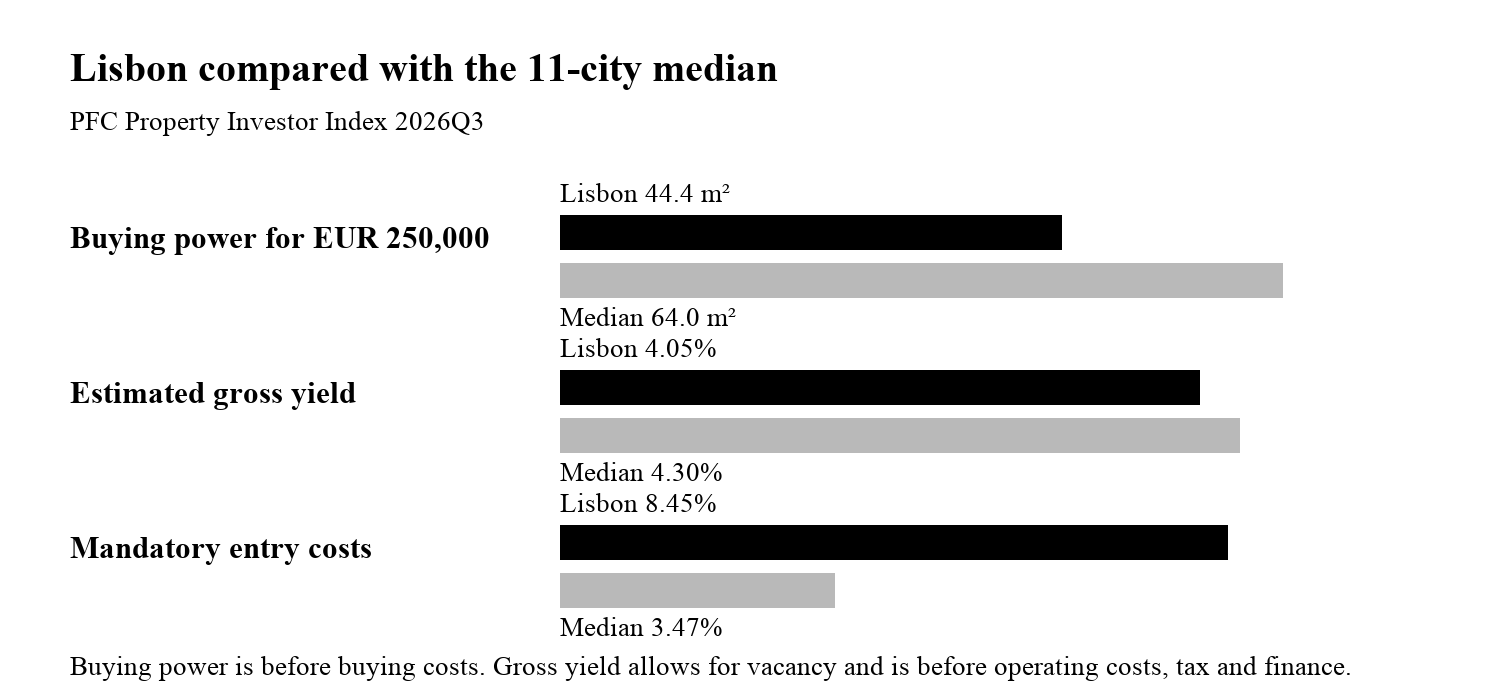
The PFC Property Investor Index estimates that EUR 250,000 buys about 44.4 square metres in Lisbon before buying costs. Lumley-Savile says that is a reasonable citywide benchmark. The same budget may buy only 30 to 35 square metres in Chiado or Príncipe Real, but 60 square metres or more in outer parishes.
The 44.4 square metre figure implies an Index price benchmark of about EUR 5,629 per square metre. This is lower than his EUR 6,200 citywide asking-price estimate because the Index combines asking-price evidence from six selected Lisbon submarkets rather than using one headline city average. Both figures are asking-price benchmarks, not completed sale prices.
The Index also estimates a 4.05 percent vacancy-adjusted gross yield. That is before management, maintenance, tax and finance. The number is useful for comparing cities, but it is not a promise for a particular apartment. In Lisbon, the intended use, the building and the street can matter as much as the city average.
The 2026 IMT change hits smaller budgets hardest
Decreto-Lei n.º 97/2026, published on 20 May 2026, introduced a flat 7.5 percent IMT rate for many residential purchases by non-residents. The practical effect is not equal at every price. Lumley-Savile expects the change to weigh most on buyers below about EUR 300,000, where the previous progressive calculation could produce a lower effective rate.
For the standard PFC cash-resale case, Lisbon has estimated mandatory entry costs of 8.45 percent. That includes 7.5 percent IMT, 0.8 percent stamp duty and a 0.15 percent registration allowance. On a EUR 250,000 property, the benchmark is about EUR 21,125. The PFC Property Investor Index 2026Q3 already includes this rule, so the tax change is part of Lisbon’s published result rather than a later adjustment.
Lumley-Savile suggests allowing roughly 10 percent above the purchase price as a broad all-in planning buffer. The PFC benchmark counts 8.45 percent of standard mandatory costs. The broader buffer leaves room for those taxes and registration charges, plus legal work, due diligence and other transaction-specific expenses.
The law includes routes to recover the difference from the normal rates if the buyer later meets specific tax-residence or qualifying long-term rental conditions. Lumley-Savile expects this to push some buyers towards long-term letting or towards becoming Portuguese tax resident. It does not make a refund automatic. The rental route includes timing, duration and rent-limit tests, and the full amount is paid at completion before any later claim.
For the full calculation, refund conditions and comparison with the other ten Index cities, read Lisbon’s 7.5 percent IMT and the investment case.
Where a local buyer adviser would look
As a buyer’s agent, Lumley-Savile would not choose an area without checking the property, building and price. He identifies several starting points for different strategies.
- Alvalade and Avenidas Novas. Established residential areas, metro access and steady long-term rental demand.
- Campo de Ourique and Estrela. Central locations and lasting appeal, with a higher entry price.
- Alcântara. River access and a district still catching up with nearby areas.
- Olivais, Benfica and Lumiar. Better value, often around EUR 4,000 per square metre, and demand from families and local tenants.
These are research starting points, not automatic recommendations. A single street, building condition or planned condominium project can change the investment case.

What foreign buyers often underestimate
Building condition and the condominium are the first risks Lumley-Savile would check. Many older Lisbon buildings need work on roofs, façades or lifts, and the owners pay for it. A buyer should read the condominium meeting minutes and check the reserve fund before signing.
This can turn an apparently cheap renovation opportunity into an expensive purchase. The condition of the apartment is only part of the risk. A weak reserve fund or planned roof, façade or lift work can create a bill that was invisible in the listing.
Rental rules come next, especially if the plan depends on short stays. Permission can change by location and licence status, so the intended use should be checked for the exact address. A strong tourist market does not mean every apartment can legally operate as a short-term rental.
James Lumley-Savile on the first legal step
“Hire your own independent Portuguese lawyer before you sign the promissory contract, not after.”
The contrato-promessa de compra e venda, usually shortened to CPCV, is the Portuguese promissory purchase and sale agreement. It can create binding obligations. An independent lawyer can check title, licences and debts on the property before the buyer commits. This is particularly important when the investment plan depends on renovation, a rental licence or a specific tax treatment.
A market for selection rather than momentum
Lumley-Savile’s outlook is for prices to rise slowly, in low single digits a year, with the best streets holding up better than weaker stock. He expects rents to remain firm because supply is limited and new construction is slow.
The local view and the Index point in the same direction. Lisbon is not a simple high-growth or high-yield purchase in 2026. Its opportunity lies in using a cooler market to negotiate firmly and reject properties whose price does not reflect tax, condition and realistic rental use.
It may suit a buyer who values international appeal, personal use or long-term demand and can accept high entry costs. It may be less suitable for an investor whose decision depends on maximum floor area, low transaction friction or a high starting yield. In this market, the property-specific checks are not a final formality. They are part of the investment case.
About the local expert

Lisbon Property
Lisbon Property is a buyer’s agent in Lisbon, helping international buyers find, assess and negotiate for homes across the city. The company contributed its local market perspective and photographs as the Lisbon expert partner for this Local Lens article.
Sources and scope
Local market observations and quotations were provided by James Lumley-Savile of Lisbon Property in October 2026. PFC figures come from the PFC Property Investor Index 2026Q3, based on data collected from July to September 2026. Portuguese tax rules are based on Decreto-Lei n.º 97/2026 and the current IMT guidance published by the Portuguese Tax and Customs Authority.
The PFC Property Investor Index compares 11 selected European cities. It does not represent every European residential market. Its rankings and estimates are research tools, not predictions, guarantees or personalised financial advice.
Explore the PFC Property Investor Index or read the methodology.