


The same budget can buy a compact central flat, a larger resale near the metro, or a three-bedroom new build on the outer ring. The surprise is that Warsaw’s new-build and resale transaction prices are now almost identical. The real trade-off is location, readiness and the costs sitting outside the advertised price.
Listing sample updated: 26 September 2026. Tax and short-stay rules rechecked: 27 September 2026. Currency conversion uses Narodowy Bank Polski reference rates published for 25 September 2026.
The PFC Property Investor Index provides the standardised city benchmark. The listings below test that benchmark against properties an investor could actually have found, so price, condition and ready-to-rent cost can produce a different result.
IN BRIEF
- €250,000 equals PLN 1,093,750 and about $284,800 at the NBP reference rates for 25 September 2026 of EUR/PLN 4.3750 and USD/PLN 3.8404.
- A cautious maximum asking price is about PLN 1.069 million for a standard resale after 2% PCC, Poland’s civil-law transactions tax, and typical notarial and registration allowances. It rises to roughly PLN 1.090 million for a VAT-inclusive new build, before fit-out, parking or storage.
- In central and near-central Warsaw, that usually means about 40 to 52 m². In Bielany, Wola’s older stock and selected outer districts, 50 to 65 m² is realistic. In Ursus, the same capital can reach a three-room new build around 55 to 65 m², but finishing costs matter.
- Current long-term asking rents imply rough gross yields around 4.4% to 5.5% on the worked examples before vacancy, management, maintenance, income tax and financing.
- The best investor value is not automatically the cheapest złoty per square metre. Metro access, a legally clean title, sensible service charges and a layout that rents easily are worth more than an extra room in a weak micro-location.
- Short-term rental is not modelled: Warsaw’s proposed registration regime is still moving through parliament, while its tax treatment differs from ordinary residential letting.
PFC capital bridge
| Capital step | Amount or treatment |
| Headline capital | PLN 1,093,750 |
| Standard resale ceiling | About PLN 1,069,000 after 2% PCC and routine closing allowances |
| New-build ceiling | About PLN 1,090,000 when the advertised price includes VAT |
| Outside the ceiling | Brokerage and renovation on resale; fit-out, parking and storage on new build |
The ceiling assumes a cash purchase and no buyer’s-agent commission. Mortgage valuation, bank, translation and power-of-attorney costs are separate. A buyer eligible for Poland’s first-home PCC exemption can move the resale ceiling close to the new-build figure.
Polish Ministry of Finance: current PCC rates Polish government: first-home PCC exemption Official maximum notarial tariff
Equal prices do not mean equal finished products
The instinctive Warsaw comparison is new build versus old stock. The data says that distinction is no longer a reliable shortcut for value.
NBP figures for Q2 2026, republished with source attribution by Deweloperuch, put the average transaction price at PLN 16,783 per m² for new apartments and PLN 16,723 per m² for resales. That is a difference of only 0.4%. Offer prices were much higher at PLN 18,488 and PLN 19,059 respectively, which also reveals a meaningful gap between advertising and completed deals.
CBRE’s end-Q2 snapshot placed the average Warsaw new-build offer price slightly higher at PLN 19,405 per m², up 6.9% year on year. Methodology and timing differ, but the investor message is consistent: the citywide label does not decide the deal. District, street, condition and extras do.
NBP and GUS Warsaw data series CBRE Warsaw and Poland Living Figures Q2 2026 Place for Capital: new build vs existing property

Warsaw’s value ladder follows transport
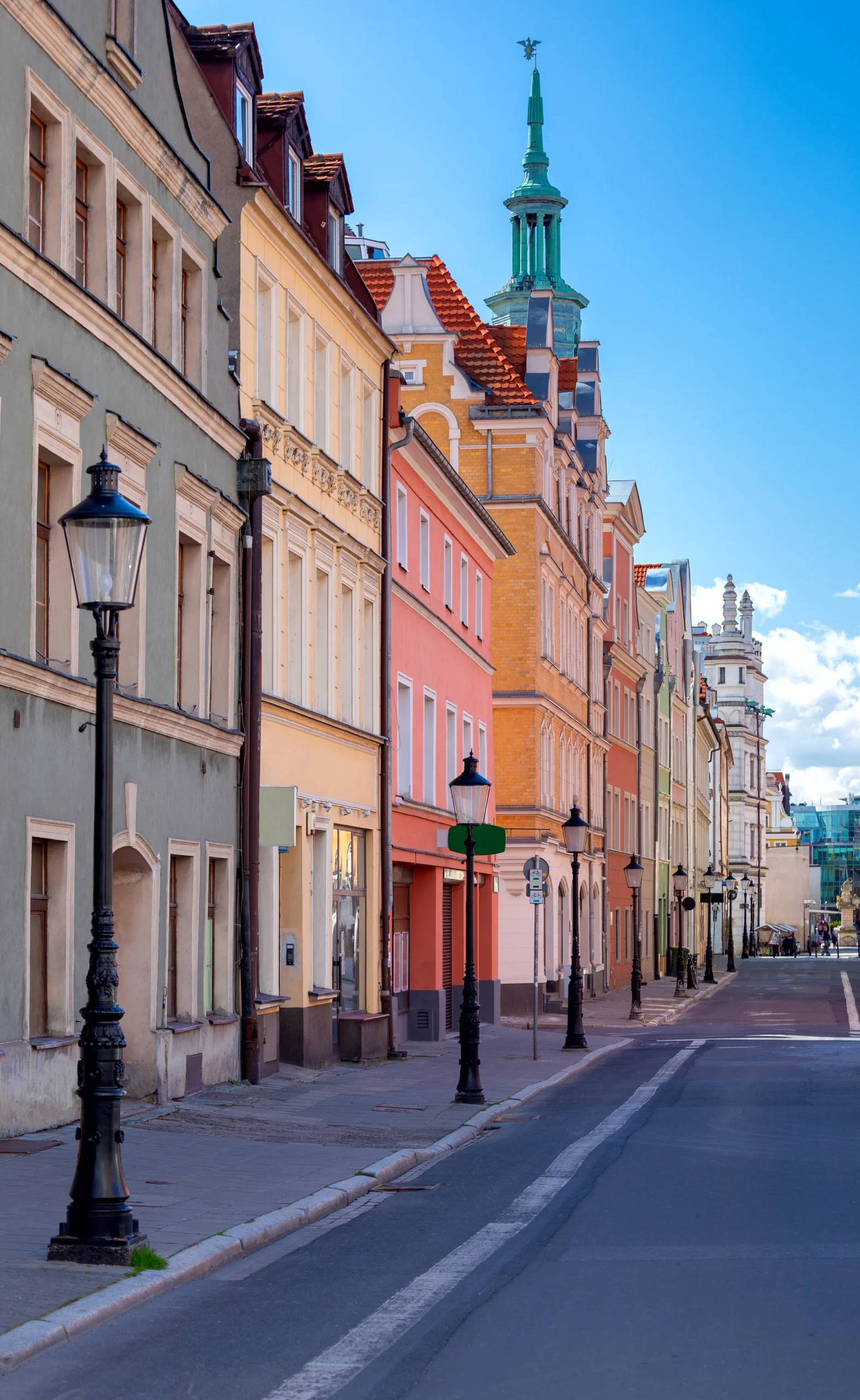
Śródmieście: location over polish
At this budget, central Warsaw is possible, but buyers must be selective. Current examples show roughly 43 to 52 m² in post-war or older buildings around the ceiling, often with compromise on finish, floor, lift or building condition. A strong street and efficient two-room layout can support demand, but service charges and renovation history deserve close scrutiny.
Wola and Mokotów: the liquid middle
Wola and Mokotów remain the most legible investor choices because employment, metro and tram access create a broad tenant pool. The budget commonly buys a good two-room apartment around 44 to 54 m². Older Wola stock can stretch to three rooms and about 65 m², while newer schemes close to central Wola compress the floor area sharply.
Bielany: more space without leaving the metro map
Bielany can deliver about 50 to 55 m² near Line M1 within the budget. That is an attractive compromise for investors who want a durable residential tenant base and better space than the centre offers.
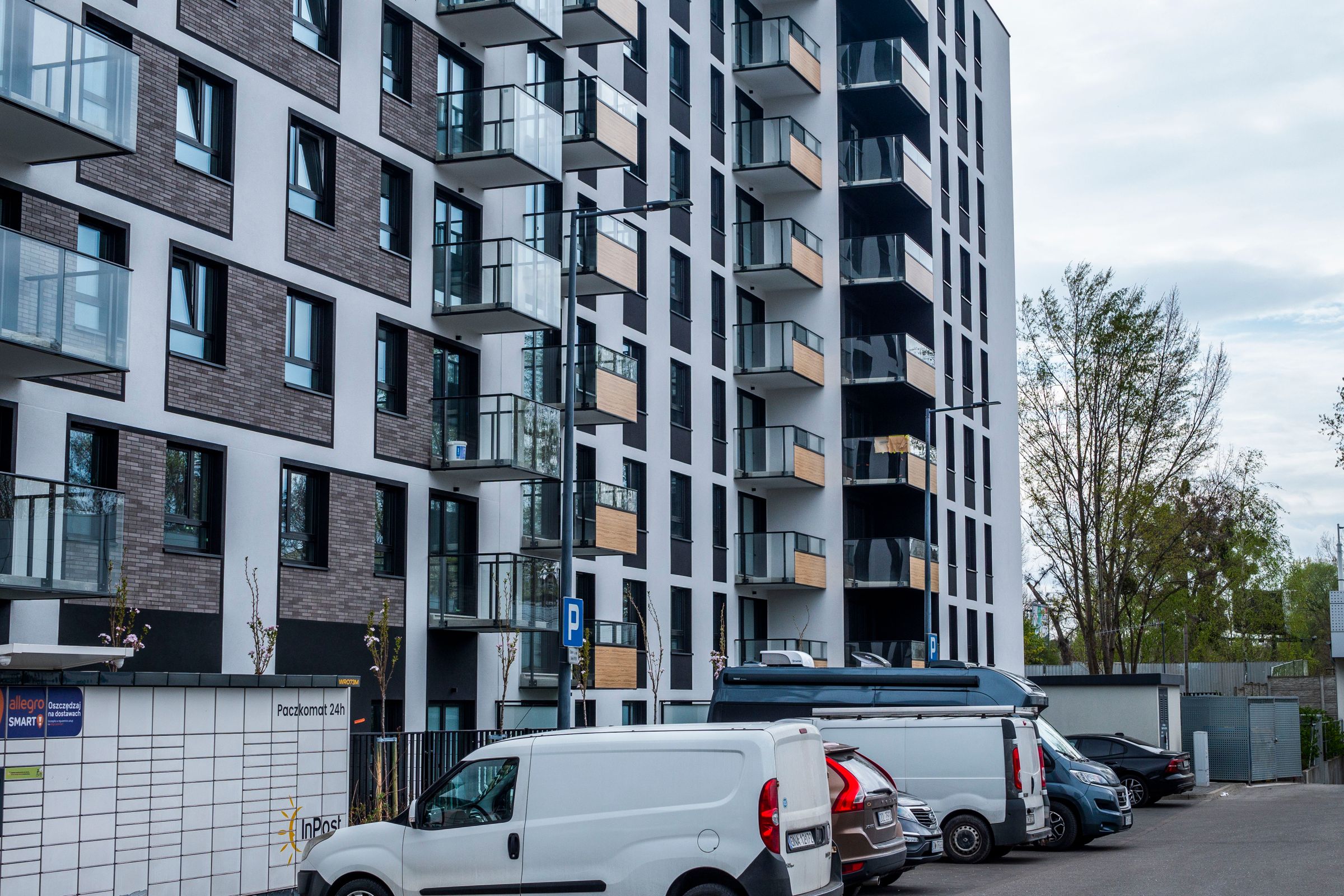
Ursus and Włochy: space, but not always a finished product
The outer western districts provide the most obvious new-build space. In Ursus, September 2026 portal data showed an average new-build asking price around PLN 15,997 per m², with the average three-room unit priced at about PLN 922,693. The catch is that a developer-standard apartment usually needs a full interior fit-out, and a parking place may be mandatory or separately priced.
Warsaw new-build market and current supply Ursus new-build prices and availability Place for Capital: Warsaw property market, prices, yields and outlook
Six listings that expose the trade-off
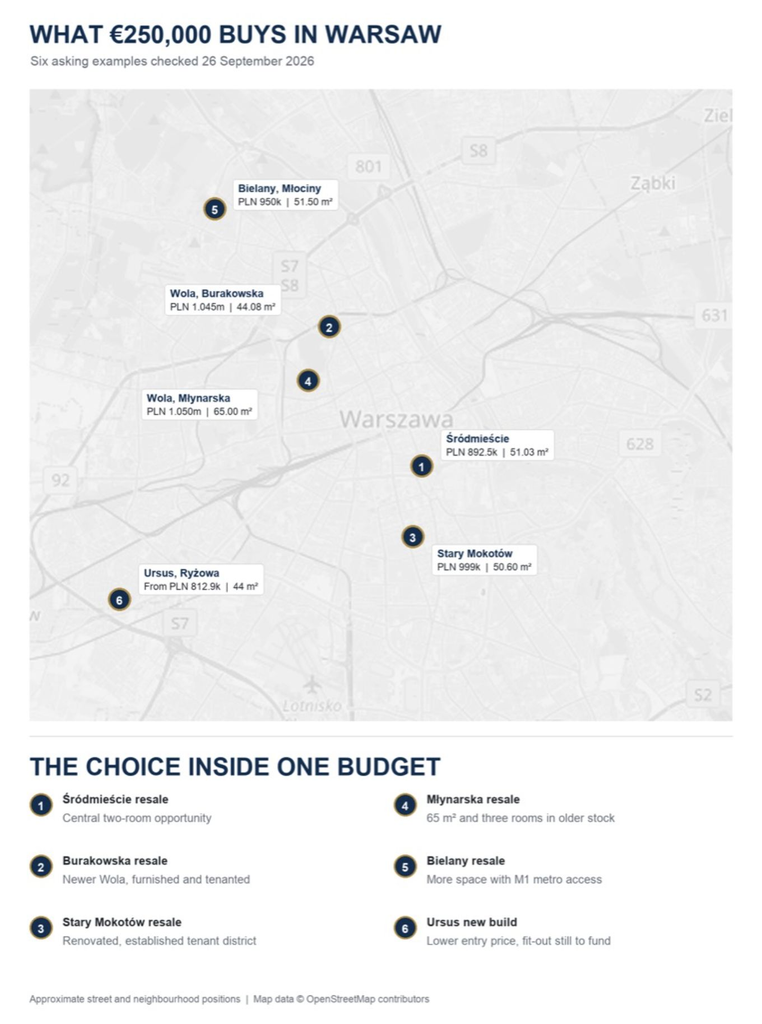
These are live-market snapshots, not recommendations or valuations. They show the choices available around the budget. Prices were checked on 26 September 2026; buyers should reopen the linked source and confirm availability, legal status and all mandatory extras.
| # | Area and source | Market | Asking price | Size | PLN/m² | What the budget is buying |
| 1 | Śródmieście Południowe, Armii Ludowej area | Resale | PLN 892,500 | 51.03 m² | PLN 17,490 | Two rooms, central address, room for due diligence and refurbishment |
| 2 | Wola, Burakowska near Arkadia | Resale | PLN 1,045,000 | 44.08 m² | PLN 23,707 | Furnished two-room unit in a newer building, advertised with a tenant |
| 3 | Stary Mokotów, Lewicka | Resale | PLN 999,000 | 50.60 m² | PLN 19,743 | Renovated two-room flat in an established residential submarket |
| 4 | Wola, Młynarska | Resale | PLN 1,050,000 | 65.00 m² | PLN 16,154 | Three rooms in a 1930s building, with garage and two balconies advertised |
| 5 | Bielany, Kasprowicza near Młociny metro | Resale | PLN 950,000 | 51.50 m² | PLN 18,447 | Two rooms with an M1 metro location and a residential tenant profile |
| 6 | Ursus, Osiedle Przy Ryżowej II | New build | From PLN 812,907 | 44.00 m² | From PLN 18,450 | Completed developer-standard unit; fit-out and parking must be confirmed |
The list exposes Warsaw’s real price ladder. A buyer can pay almost the same total price for 44 m² in a newer Wola building or 65 m² in older Wola stock. The missing 21 m² is the price of age, specification, building risk and tenant-ready condition.
Why the metro two-room is the practical answer
Current asking-rent evidence supports a broad PLN 3,500 to PLN 5,000 monthly base-rent range for the two-room examples, depending on exact location, finish and building. Three-room units in outer districts can sit around PLN 3,800 to PLN 4,500. Polish listings often show the owner’s base rent separately from the tenant’s administrative charge and utilities, so yield calculations must use the base rent only.
| Worked case | Base rent used | Indicative all-in basis | Gross yield |
| Śródmieście, 51 m² resale | PLN 4,200/month | PLN 915,000 | 5.5% |
| Wola, 44 m² newer resale | PLN 4,500/month | PLN 1,070,000 | 5.0% |
| Stary Mokotów, 51 m² resale | PLN 4,000/month | PLN 1,025,000 | 4.7% |
| Wola, 65 m² older resale | PLN 4,500/month | PLN 1,075,000 | 5.0% |
| Bielany, 52 m² resale | PLN 3,600/month | PLN 974,000 | 4.4% |
| Ursus, 61 m² new build after indicative fit-out | PLN 3,800/month | PLN 1,020,000 | 4.5% |
The first case looks strongest partly because its asking price is below the budget ceiling. That is exactly why yields should be calculated property by property, not from a city average. Net yield will be lower after vacancy, maintenance, insurance, management, owner-paid charges and tax.
Śródmieście two-room rental comparables Mokotów two-room rental comparables Ursus rental comparables Place for Capital: gross vs net rental yield Place for Capital: rental yield explained
Ready-to-rent cost decides the winner
Resale friction
A standard resale normally carries 2% PCC (podatek od czynności cywilnoprawnych), a civil-law transactions tax collected through the notarial process. An eligible first-home buyer may be exempt, but investors who already own property should not budget on that basis.
Brokerage is negotiable and market practice varies. If the buyer owes a 2% plus VAT fee, a near-ceiling listing can immediately fall outside the capital limit. Renovation is the other large swing item, particularly in pre-war and early post-war buildings.
Developer price is not the finished price
The advertised developer price normally includes VAT, or value-added tax, generally at 8% for a conventional home in this size band, so standard PCC is usually not added. A private investor should not assume VAT recovery. Flooring, kitchen, lighting, wardrobes and bathroom completion can still create a six-figure złoty bill; parking and storage may also be mandatory.
The practical rule is simple: compare ready-to-rent cost, not purchase price. A PLN 925,000 shell plus PLN 95,000 of fit-out and PLN 50,000 of parking is not cheaper than a PLN 1.02 million resale that can be let after minor work.
Place for Capital: hidden costs of buying property in Europe Place for Capital: buying with cash or a mortgage
Short stays are not a second yield case
As of 27 September 2026, Poland’s short-term-rental bill had passed its first reading but was not final law. It proposes a central register and possible future municipal restrictions. Ordinary residential rent is generally VAT-exempt; accommodation services are generally taxed at 8% when VAT applies. Because the rules and operating costs differ, this article models long-term rent only.
Polish parliament: bill 2865 Polish Ministry of Finance: VAT rates and limits Polish Ministry of Finance: residential-rent VAT interpretation
Ownership is simpler than the rental strategy
For a conventional Warsaw apartment, the answer is usually yes. Polish government guidance states that citizens and businesses from the European Economic Area and Switzerland do not need a ministerial permit. It also lists the acquisition of an independent residential unit as permit-exempt for other foreign citizens, subject to the statutory exceptions, including border-zone rules. Warsaw is not in a border zone.
The exemption does not remove normal legal due diligence. The buyer should verify the land and mortgage register, ownership title, encumbrances, arrears, building records, planning context and the legal status of any parking or storage. A Polish notary is required for the transfer, but the notary does not replace the buyer’s independent legal review.
Polish Ministry of the Interior: permit rules for foreign buyers
The seven checks behind the two-room thesis
- Księga wieczysta: ownership, mortgages, claims, easements and correspondence with the apartment being sold.
- Title type: separate ownership is usually easiest for an international buyer to understand; cooperative ownership rights need specific legal review.
- Service charges: obtain the current statement and ask what is owner-paid versus recoverable from the tenant.
- Building capital works: roofs, façades, lifts, risers and heating upgrades can alter the investment case.
- Tenant status: confirm whether the apartment is vacant and whether any advertised tenant or lease transfers on terms acceptable to the buyer.
- New-build attachments: confirm the exact price of parking, storage, fit-out, handover timing and defect procedure.
- Rentability: favour a separate bedroom, practical storage, lift where relevant, reliable transit and a base rent supported by nearby evidence.
Place for Capital: seven numbers to check before buying an investment property Place for Capital: how to compare European property markets
Buy the tenant pool, not the largest floor plan
€250,000 is enough to make a credible Warsaw investment, but not enough to ignore the product choice. The budget reaches central Warsaw, yet a buyer who spends every złoty on postcode can end up with a smaller unit, heavier building risk and a weaker cash buffer. Wola, Mokotów and metro-connected Bielany provide the most balanced mix of tenant depth, space and liquidity. Ursus offers more bedrooms, but only when fit-out and commuting trade-offs are priced honestly.
The strongest brief for this budget is a well-laid-out two-room resale of roughly 45 to 55 m² near metro or fast tram links, bought below the absolute ceiling and with documented building costs. A three-room outer-district new build can be equally rational for a family-rental strategy, but only if the ready-to-rent total remains below PLN 1.094 million.
Place for Capital: Budapest vs Warsaw, where does €250,000 go further? Place for Capital: what €250,000 buys in Budapest Place for Capital newsletter
This article is general market information, not legal, tax, investment or valuation advice. Prices, exchange rates, taxes, rents and listing availability can change. Obtain current Polish legal and tax advice before committing capital.